My 2025 Reading Year in Review!
I managed to read 65 books this year. As an end-of-year victory lap, here's a few highlights, and a couple of suggested personal curricula. My full reading list for the year is all the way at the bottom, if you're here for that for some reason.

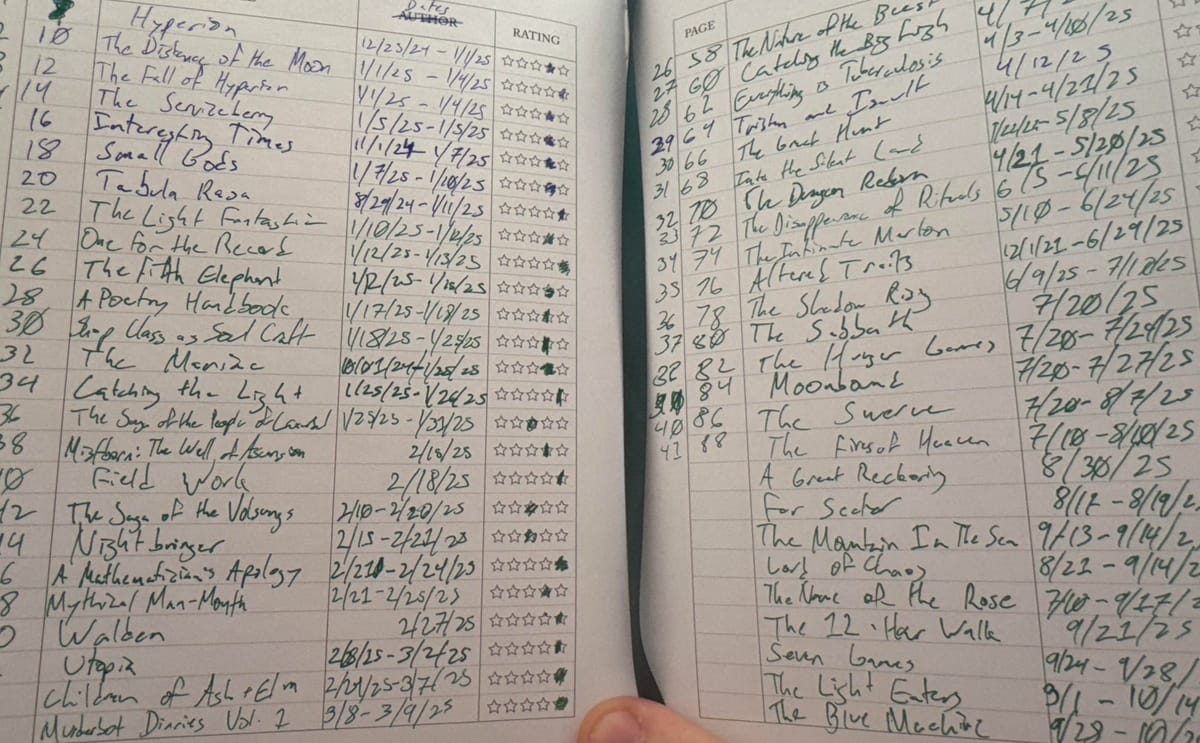
As of this writing (Dec. 9), I've read 65 books this year. That count might go up a touch more by the end, but all in, I managed to cram a ton of reading into 2025. I chalk that up to a few things: better habits, an e-ink tablet (for reading PDFs, ePubs, and of course Kindle and Kobo books), and a healthy balance between nonfiction and fiction. Check out Thought Couture's video on reading routines for a fun perspective on a reading diet.
As an end-of-year victory lap, here's a few highlights, and a couple of suggested personal curricula. My full reading list for the year is all the way at the bottom, if you're here for that for some reason.
The Best of The Best
There were a few real standouts for me this year. Note: these aren't necessarily books published this year, just great books I read this year. Each one gets my wholehearted endorsement!
In no particular order, here's three great novels and three great nonfiction works:
- Moonbound by Robin Sloan – a fantastic Arthurian retelling set in a distant future, Sloan continues his streak of stories imagining versions of our world with just a little bit more magic. It's the first book I've ever read that left me thinking "I wish I had kids to read this to".
- The Sabbath: Its Meaning for Modern Man by Abraham Joshua Heschel – a wonderful meditation on the importance of rest. More important than ever, and a restorative read.
- The Lies of Locke Lamora by Scott Lynch – some of the best dialogue I've ever read. It's a romp of a heist set in a rich, brutal world. It's a great time.
- The Mountain in the Sea by Ray Nayler – a tremendous meditation on other forms of sentience, and the importance of communal intelligence.
- Into the Silent Land by Fr. Martin Laird, OSA – The form of contemplative prayer studied here is incredibly similar to Zen meditation, a practice focused on stillness, emptiness, and encountering the divine in the quiet.
- Children of Ash and Elm by Neil Price – a delightful overview of Viking history, exploring and explaining their society and impact on the rest of the world.
Personal Curricula
Based on this year's reading and leaning into this trend of personal curricula, here's a few sets of books that could make for interesting deep dives around certain themes! If you try one out, let me know!
On The Universal Importance of Meditation
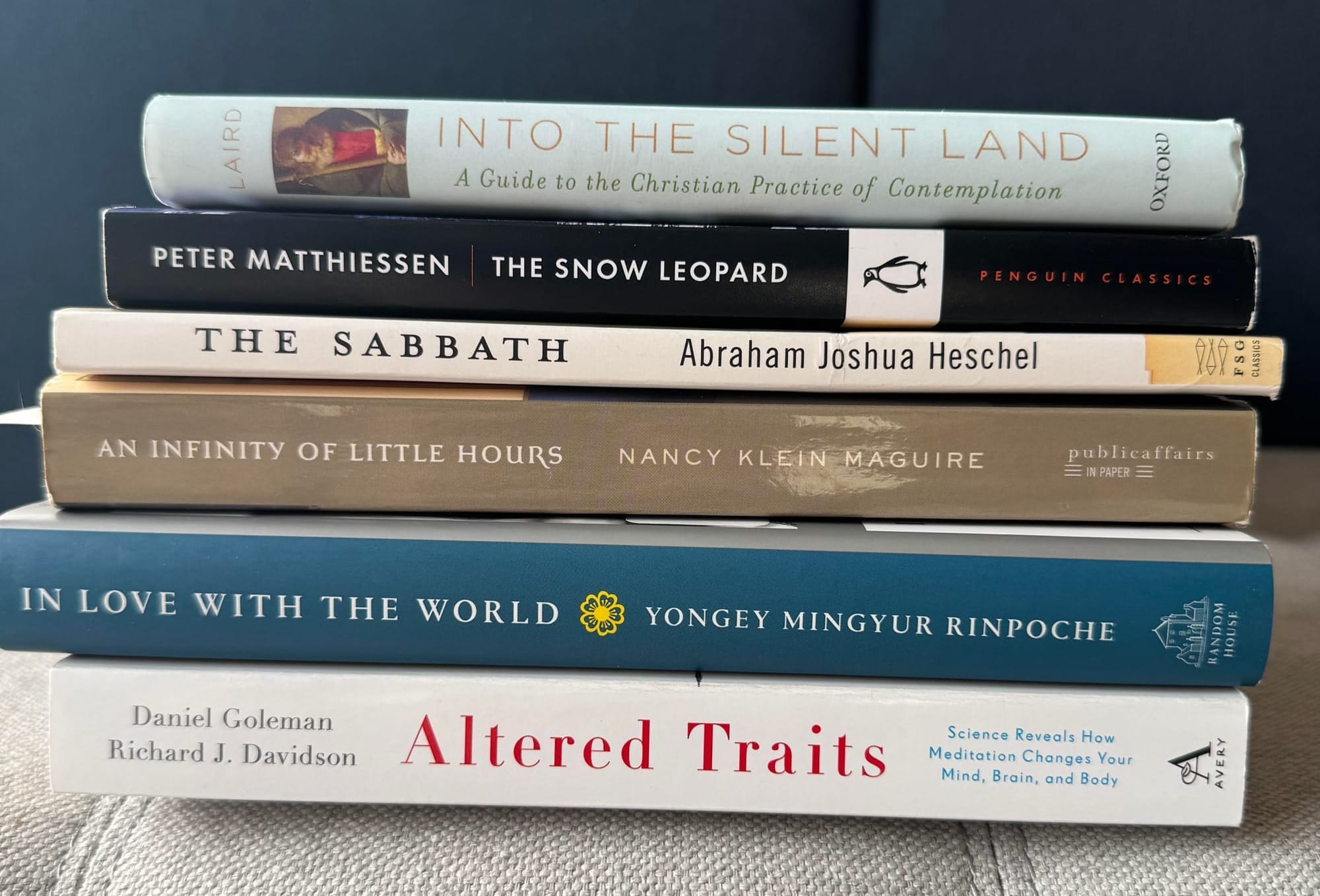
These six books all center on the restorative power of stillness, each in a different way. I've already mentioned Fr. Laird's Into the Silent Land, which serves as an instruction manual to contemplative meditation through a Christian lens, as well as The Sabbath.
An Infinity of Little Hours explores life in a Carthusian monastery, one of the most austere and intense orders in Catholicism. Though most of the men profiled in the book do not make it through their time as novitiates in the order, they all left with a profound respect for the form of prayer they learned there, and most of them continued it for the rest of their lives (albeit in a less-severe form).
The severity continues with In Love With The World, where Yongey Mingyur Rinpoche leaves his post at the head of a Buddhist monastery and becomes a wandering beggar in search of enlightenment. His journey, both internal and external, is beautifully narrated and will leave the more basic practitioner feeling grateful for their comfortable seat.
Altered Traits is a more academic work, looking at the physiological changes that consistent and meaningful meditation can produce in a person. The moral: meditation is great for you. Keep an eye out for cameos from another of these works: Yongey Mingyur Rinpoche is one of the monks that Goleman and Davidson studied!
Occasionally, a writer strikes me so deeply that I institute a policy: buy anything of theirs I ever see in the wild, on the spot. That list includes Le Guin, Whitehead, VanderMeer, Harjo, Kerouac, and now, Matthiessen. The Snow Leopard is an intense journey through Nepal, where the author tagged along on a biological expedition in search of a Tibetan lama reportedly teaching high up in the mountains. Part scientific journey, part memoir, the grief and stillness that pervade this book are truly incredible, yet for some reason Matthiessen is hard to find in bookstores near me. I plan to read much more of his more of his work in the new year.
On the Relational Nature of The Universe
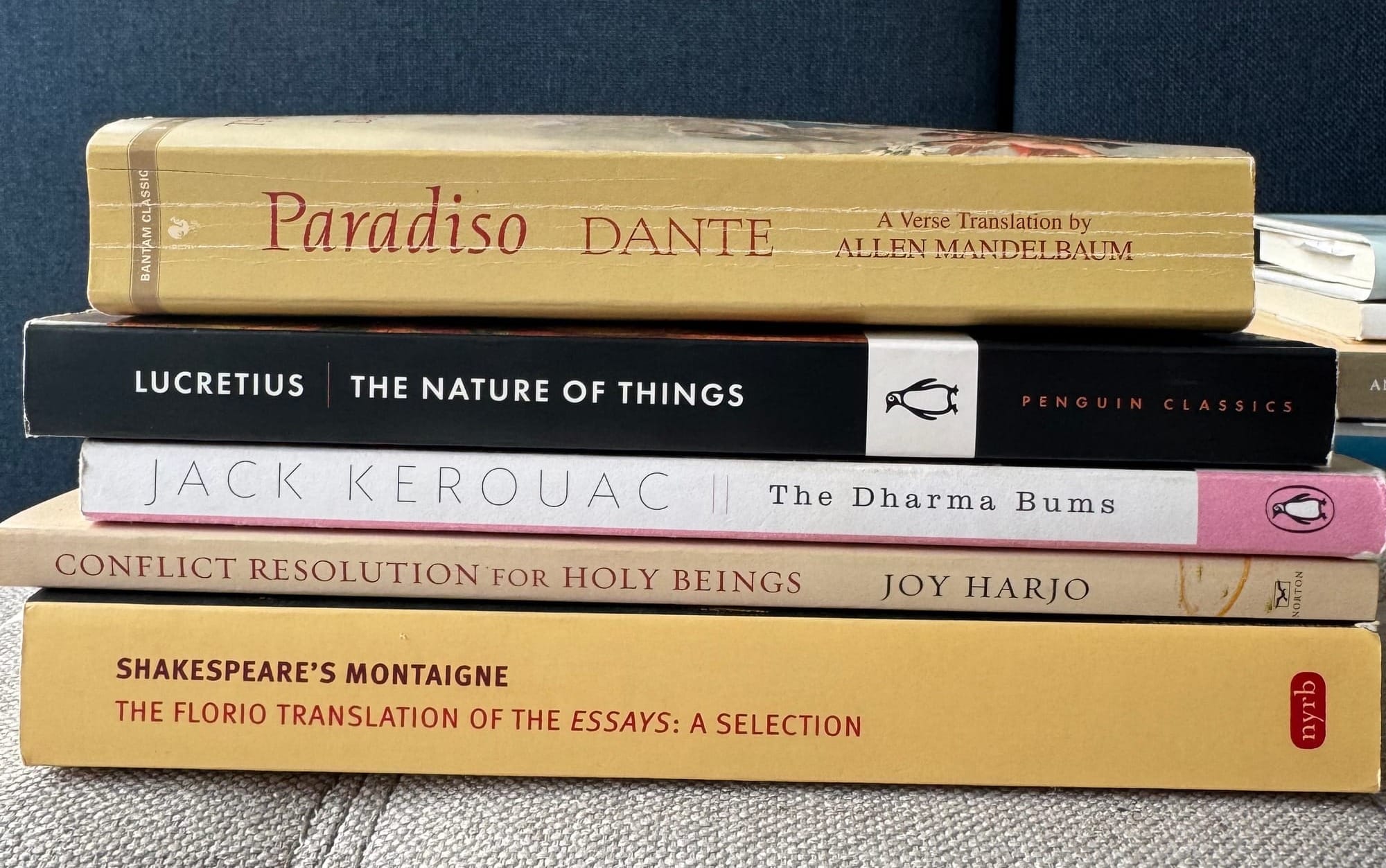
This one's largely based on my work with Professor Theoharis in my graduate studies, an incredible literature teacher who guided me through both Joyce and Dante and left me a far better reader for both. Many of these works were included in my last paper for him, which you can read here, but I've added a couple since then. Joy Harjo is my favorite American poet, a Mvskogee woman from Tulsa and a former Poet Laureate of the US. Her work is incredible and I cannot recommend it highly enough. The Nature of Things was a prescient work that anticipated particle physics thousands of years ago and nearly disappeared in the Middle Ages (read The Swerve for more on that story).
Meanwhile, Montaigne captured the relational nature of the world in one of his essays when he wrote "The world is but a perennial movement. All things in it are in constant motion — the earth, the rocks of the Caucasus, the pyramids of Egypt — both with the common motion and with their own. Stability itself is nothing but a more languid motion." It never hurts to read more Montaigne.
In keeping with this theme, one of my resolutions is to finally finish McGilchrist's The Matter With Things, which I quoted in the above paper but have never completed. It's a two volume work that deserves intentional work, so I've procrastinated finishing for too long.
On the Betterment of Society
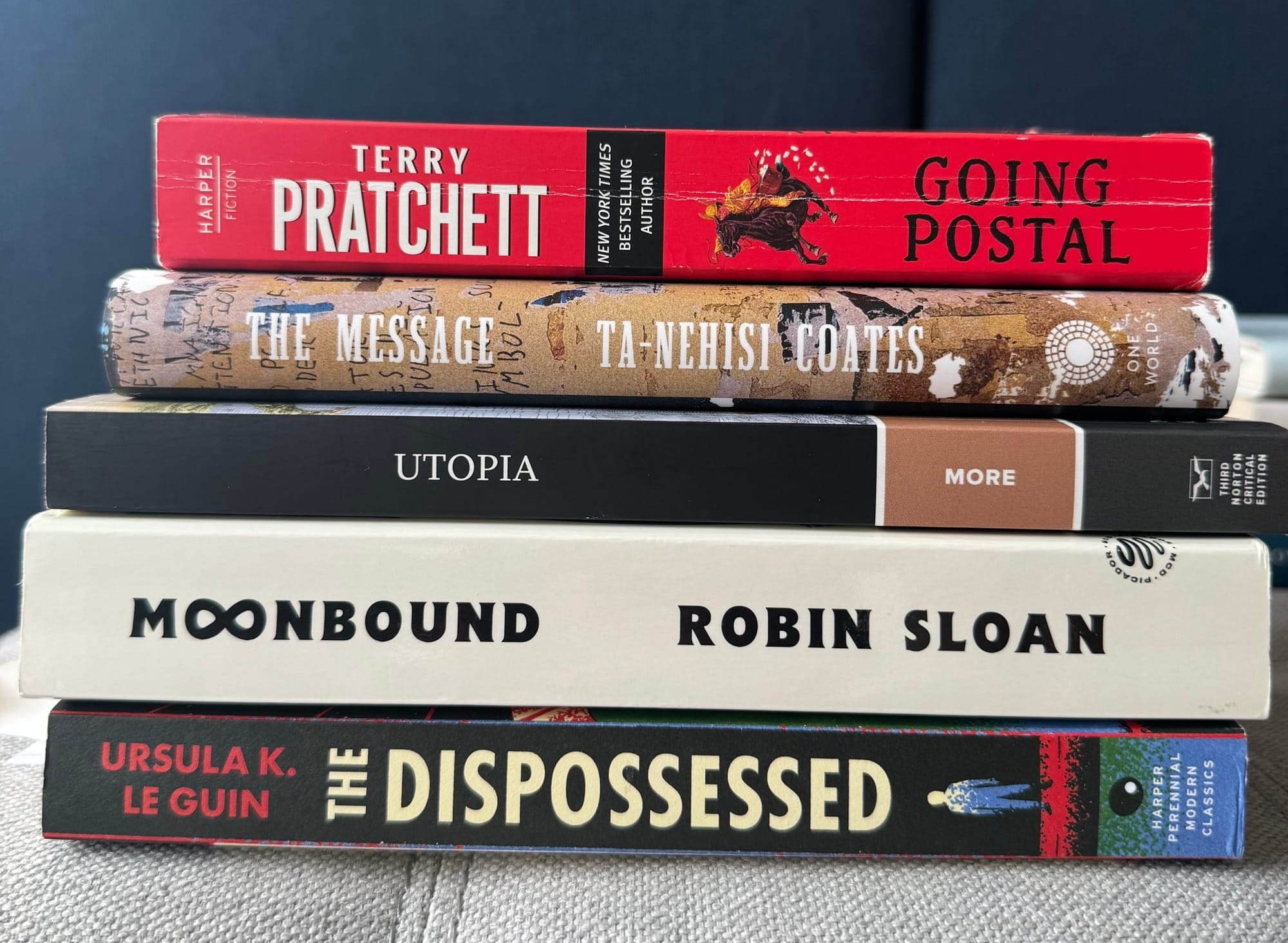
There is no such thing as a perfect world, but we can always strive for improvement nonetheless. To imagine a better society, I think it's important to balance keeping informed with looking forward, maintaining a delicate balance of depression and optimism. Here, we have several works that might inspire future action.
The Message is Coates' exploration of Israel and Palestine. It's an important eyewitness account from a leading voice on systemic hatred, but it's not an easy read, either. This serves as our reminder of the world as it stands today, full of division and hatred, ignorance and reductive thinking.
More's Utopia is a foundational work, a quick read worth getting under your belt before considering the deep issues of social structure. Remember: utopia is Greek for no-place.
Moonbound has already been touched on, but The Dispossessed is my current read and I think the two go hand in hand beautifully. The anarchism Le Guin explores on Anarres is worth thinking through because it raises the question: what does a perfect society look like? Is it a world where nobody works, or one where everybody does? Sloan brings his own answer to life in Moonbound.
Meanwhile, Pratchett does what he does best in Going Postal when he delves into the conflict between society's need for public services and society's disinterest in supporting public services.
This might be the first reading list with Palestine and Pratchett together, but it shouldn't be the last.
Below this is the full list of books I read this year, which I'll update if I sneak in a couple more in these last few weeks. Got any recommendations for me to check out in 2026? Reach out!
May your winter be warm and your holidays filled with welcome company, good food, and better books.
Every Book I Finished in 2025
In order of completion date
Hyperion (Hyperion Cantos, #1) – Dan Simmons
The Distance of the Moon – Italo Calvino
The Fall of Hyperion (Hyperion Cantos, #2) – Dan Simmons
The Serviceberry: Abundance and Reciprocity in the Natural World – Robin Wall Kimmerer
Interesting Times (Discworld, #17; Rincewind, #5) – Terry Pratchett
Small Gods (Discworld, #13) – Terry Pratchett
Tabula Rasa: Volume 1 – John McPhee
The Light Fantastic (Discworld, #2; Rincewind, #2) – Terry Pratchett
Hank Aaron: One for the Record, The Inside Story of Baseball's Greatest Home Run – George Plimpton
The Fifth Elephant (Discworld, #24; City Watch, #5) – Terry Pratchett
A Poetry Handbook: A Prose Guide to Understanding and Writing Poetry – Mary Oliver
The MANIAC – Benjamin Labatut
Shop Class as Soulcraft: An Inquiry into the Value of Work – Matthew B. Crawford
Catching the Light (Why I Write) – Joy Harjo
The Saga of the People of Laxardal / Bolli Bollason's Tale – Anonymous
The Well of Ascension (Mistborn, #2) – Brandon Sanderson
Field Work: Poems – Seamus Heaney
The Saga of the Volsungs – Anonymous
Nightbringer: 20th Anniversary Edition (The Chronicles of Uriel Ventris: Warhammer 40,000 Book 1) – Graham McNeill
A Mathematician's Apology – G.H. Hardy
The Mythical Man-Month: Essays on Software Engineering – Frederick P. Brooks Jr.
Walden – Henry David Thoreau
Utopia – Thomas More
Children of Ash and Elm: A History of the Vikings – Neil Price
All Systems Red (The Murderbot Diaries, #1) – Martha Wells
The Nature of the Beast (Chief Inspector Armand Gamache, #11) – Louise Penny
Catching the Big Fish: Meditation, Consciousness, and Creativity: 10th Anniversary Edition – David Lynch
Everything Is Tuberculosis: The History and Persistence of Our Deadliest Infection – John Green
The Romance of Tristan and Iseult РJoseph B̩dier
The Great Hunt (The Wheel of Time, #2) – Robert Jordan
Into the Silent Land: A Guide to the Christian Practice of Contemplation – Martin Laird
The Dragon Reborn (The Wheel of Time, #3) – Robert Jordan
The Disappearance of Rituals: A Topology of the Present – Byung-Chul Han
The Intimate Merton: His Life from His Journals – Thomas Merton
Altered Traits: Science Reveals How Meditation Changes Your Mind, Brain, and Body – Daniel Goleman
The Shadow Rising (The Wheel of Time, #4) – Robert Jordan
The Sabbath: Its Meaning for Modern Man – Abraham Joshua Heschel
The Hunger Games (The Hunger Games, #1) – Suzanne Collins
Moonbound – Robin Sloan
The Swerve: How the World Became Modern – Stephen Greenblatt
The Fires of Heaven (The Wheel of Time, #5) – Robert Jordan
Far Sector – N.K. Jemisin
Green Lantern by Geoff Johns, Book One – Geoff Johns
A Great Reckoning (Chief Inspector Armand Gamache, #12) – Louise Penny
Green Lantern by Geoff Johns, Book Two – Geoff Johns
Lord of Chaos (The Wheel of Time, #6) – Robert Jordan
The Mountain in the Sea – Ray Nayler
The Name of the Rose – Umberto Eco
The 12-Hour Walk: Invest One Day, Conquer Your Mind, and Unlock Your Best Life – Colin O'Brady
Seven Games: A Human History – Oliver Roeder
The Light Eaters: How the Unseen World of Plant Intelligence Offers a New Understanding of Life on Earth – Zoe Schlanger
The Blue Machine: How the Ocean Works – Helen Czerski
The Snow Leopard – Peter Matthiessen
The Lies of Locke Lamora (Gentleman Bastard, #1) – Scott Lynch
Storm Front (The Dresden Files, #1) – Jim Butcher
Fool Moon (The Dresden Files, #2) – Jim Butcher
Grave Peril (The Dresden Files, #3) – Jim Butcher
Summer Knight (The Dresden Files, #4) – Jim Butcher
Mr. Penumbra's 24-Hour Bookstore (Mr. Penumbra's 24-Hour Bookstore, #1) – Robin Sloan
Tripwire (Jack Reacher, #3) – Lee Child
Red Seas Under Red Skies (Gentleman Bastard, #2) – Scott Lynch
The Dragon Waiting – John M. Ford
An Infinity of Little Hours: Five Young Men and Their Trial of Faith in the Western World's Most Austere Monastic Order – Nancy Klein Maguire