The Science Lines Up With The Faith
A new study on the cognitive effects of AI dovetails nicely with the Pope's encyclical, Magnifica Humanitas.

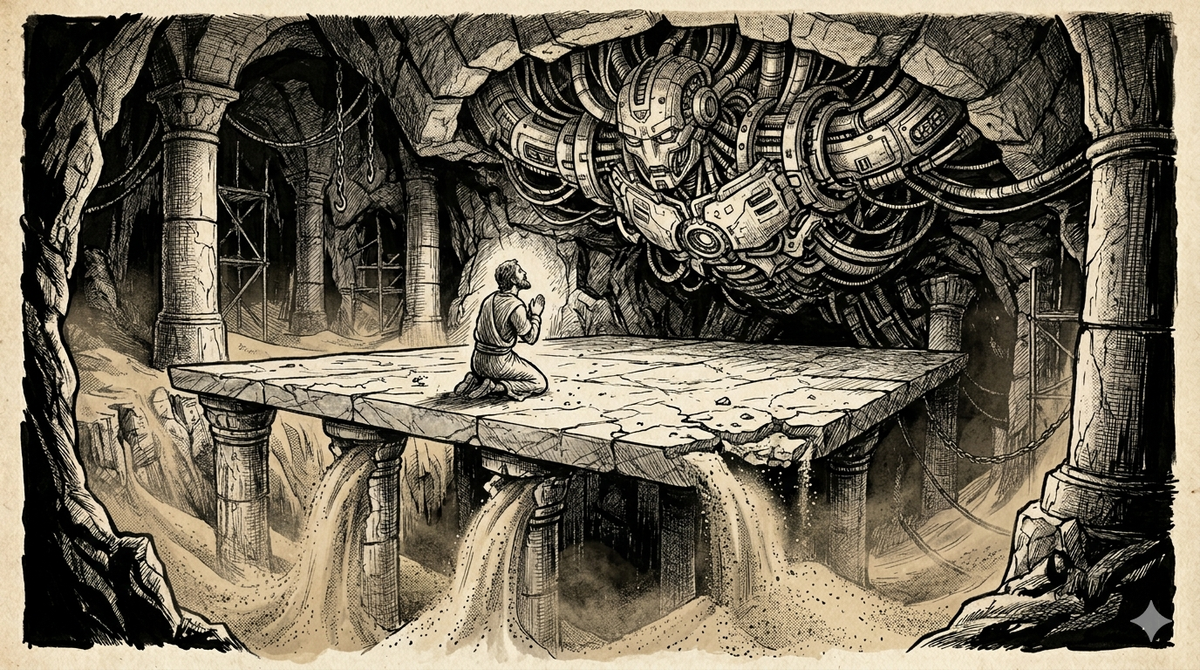
"Thou shalt not make a machine in the likeness of a human mind." – The Orange Catholic Bible
In my initial notes on Magnifica Humanitas, I wrote that my own approach to AI centered on using AI to implement solutions of my own making, not using AI to "solve" problems on its own. I struggle to shake a queasiness whenever I use AI, but when I watch it implement something I've planned, there's a level of satisfaction too. ("Yes, little dumb robot, turn my 500 words into a piece of code.") In a world full of engineers and developers running a half-dozen threads and agentic conversations, I'm moving slow, but I've maintained a grasp on what I'm doing.
On the rare occasions when I've pointed AI at a bug and said "solve that", that queasiness intensifies. I watch a solution spin out from nowhere and everywhere (remember that every AI generation starts from training datasets often filled with questionably acquired human work, often classified and sorted by underpaid, overworked, uncredited teams in the Global South), and I can't help but feel disconcerted. The power dynamic has shifted, the source of control and expertise out of my hands.
I'm no longer the orchestrator of an army of drones marching forth to do my bidding; I'm supplicating myself at a cardboard cutout of the Oracle at Delphi, begging for a prophecy to rely upon. Relinquishing authority to an AI feels wrong on a few levels, but the one I want to focus on the cognitive effects of the shift.
When you outsource the cognitive load of problem-solving, a slippery mental slope appears. Your brain sees an opportunity to cut corners, to stop doing the work itself. It's the same lazy/efficient mechanism that finds the gentlest slope up a hill: we're built to conserve energy! If we can outsource the work, our brains reason, why shouldn't we?
If you listen closely, in a quiet room, you can hear the rustle of newly obsolete synaptic pathways drying up.

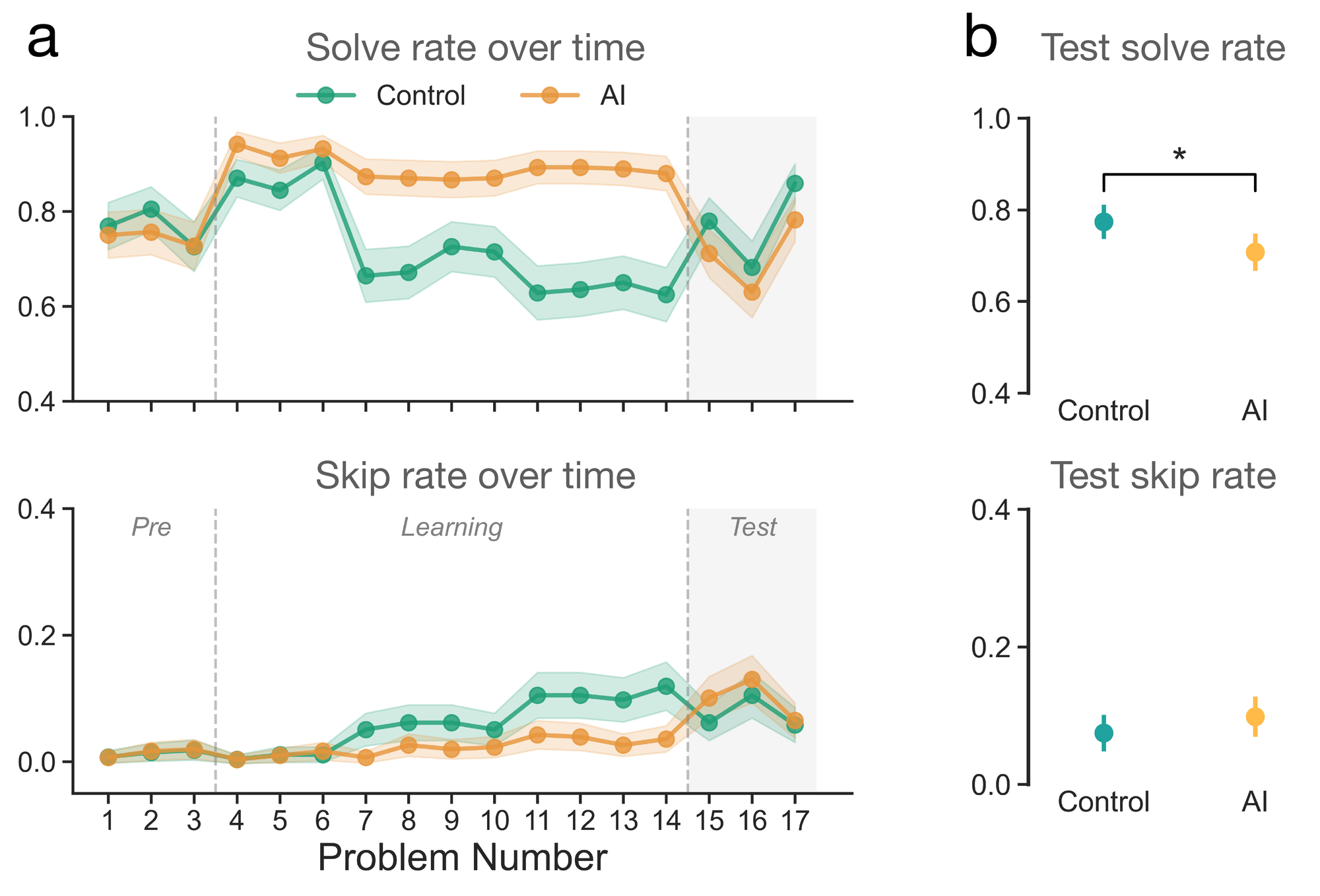
Now, that concept has been validated by a team from Carnegie Mellon, Oxford, MIT, and UCLA. They tested participants on math and reading problems. "In the AI condition, participants solved 12 fraction problems with an AI assistant (GPT-5) available in a sidebar. The AI was then removed without warning, and all participants solved 3 additional test problems independently." Users could use the AI how they wanted. The results are telling.
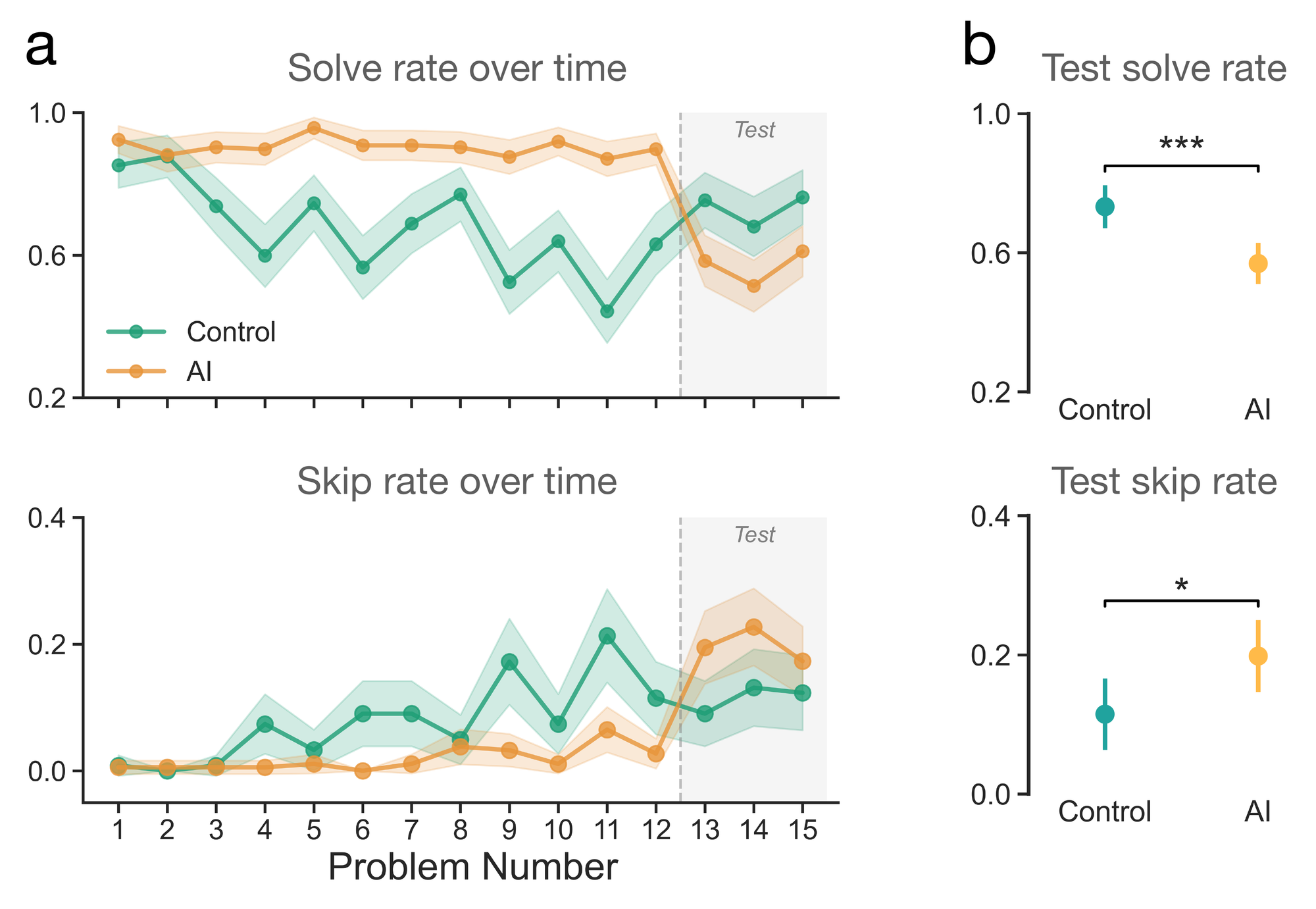
When the AI shut off, subjects' ability to solve the math problems plummeted.
Then, the team replicated the findings with some increased controls for better methodology. The results showed the same trend.
They ran a similar experiment with SAT reading questions:
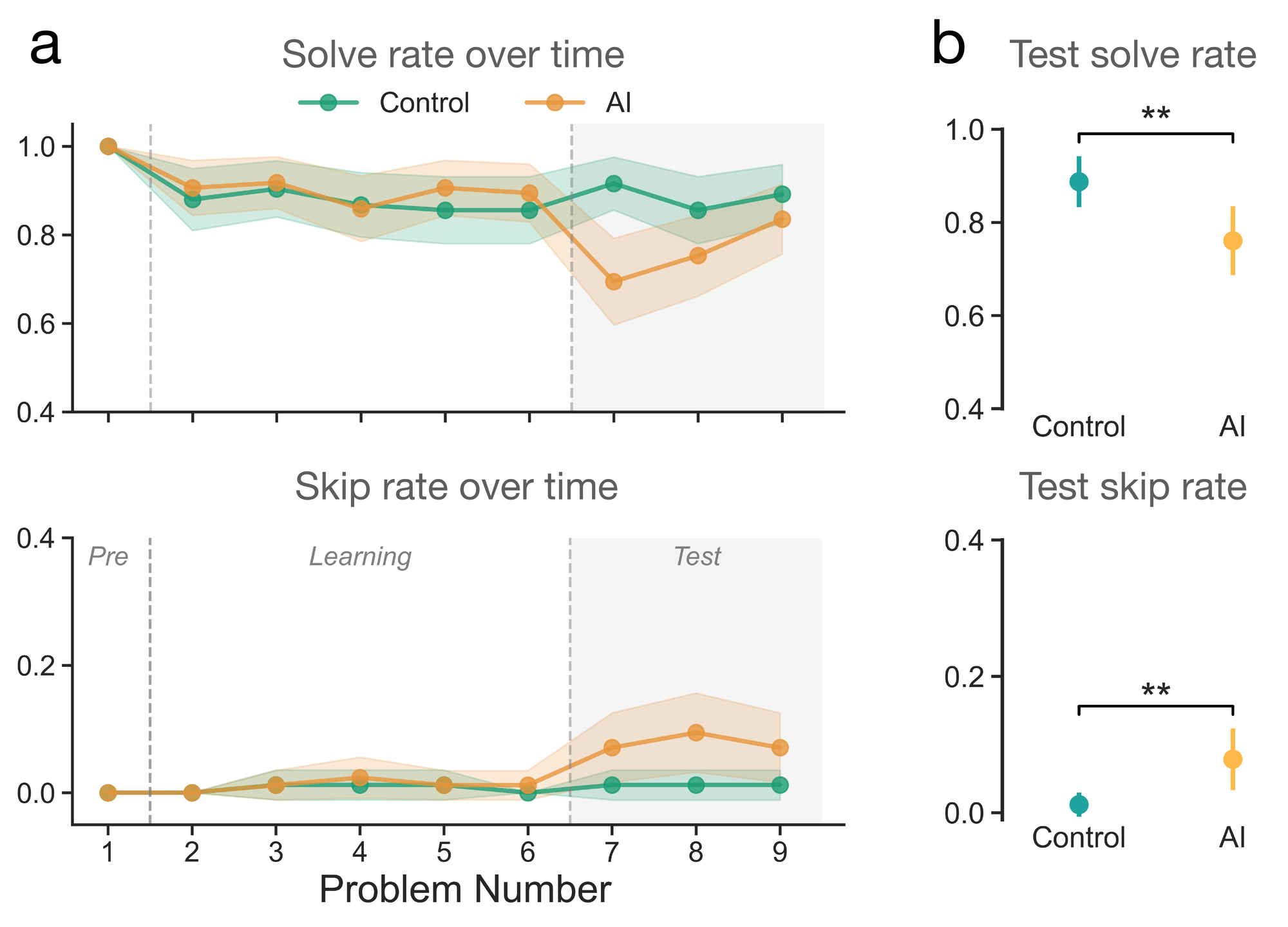
Each iteration produced the same trend: take away the AI, and there's an immediate drop in performance followed by a slow recovery. That applies across the board, but there's a second level to the results: "the majority of participants (61%) used AI to get answers directly. These participants showed the largest declines in performance and persistence — not only compared to control participants but also compared to participants who used AI for hints or clarifications. Participants who used AI for hints showed no significant impairments relative to control."
This is one paper, and more data could always shift the narrative. However, these results also show how quickly cognitive performance can deteriorate, especially when AI replaces, rather than assists, human problem-solving.
Of course, not all problem-solving is created equal.
Using AI as the first option to approach and address complicated problems will erode users' ability to handle future complexity, undermining their expertise over time. Expertise in any field emerges from the mastery of component challenges, the understanding of how parts fit together as a whole. Weaken the pillars, and the building crumbles.
I worry most about those who use AI to write and summarize reading. Literacy is a crucial foundation for critical thinking, empathy, and all-around wellbeing. Compounding the preexisting opponents of literacy and attention (TV, social media, etc.) with the ability to outsource reading and writing altogether? That's a frightening prospect.
Turn back to Pope Leo XIV's guidance.
"This is the guiding principle for technological processes: it is not enough for artificial intelligence to make us more efficient or connected; it must also serve to build a universal human family, with shared rights and duties, where digital proximity becomes a real opportunity for encounter and mutual care" (Magnifica Humanitas 187).
Seems to me that these technologies, when given primacy over a problem, do the opposite. They make our minds weaker, reduce our comprehensive abilities.
What Now, Then?
I despise the forced inevitability of AI. It should not be unstoppable or unavoidable, and I of course agree with His Holiness when he says that it should be disarmed. But at the same time, I have to use it. In the arms race of the tech sector, familiarity with this technology has become a baseline requirement for software development, and as I've said before, it can be superbly valuable when used with intention, not set loose on a codebase.
Even still, I worry about losing my grasp on certain fundamentals of software development, things that I have to seek out, slow down, and do by hand to ensure I don't lose them. I worry about slipping down that slope of cognitive laziness, about my own expertise eroding slowly under my feet.
Diligence. Self-reflection. Avoiding the worst, most blatant erosion of my human brain whenever possible. Pushing back on processes that are AI-first, agentic, or "autonomous". Those won't be sustainable.
Reject the inevitability. Embrace friction, and do things the human way. Keep the machine in its place.
Works Cited
 Grace Liu1