Overwhelms Past, Present, and Future
Reflecting on my time in Rome at the Villanova International Sustainability Conference
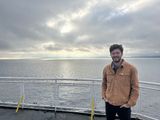
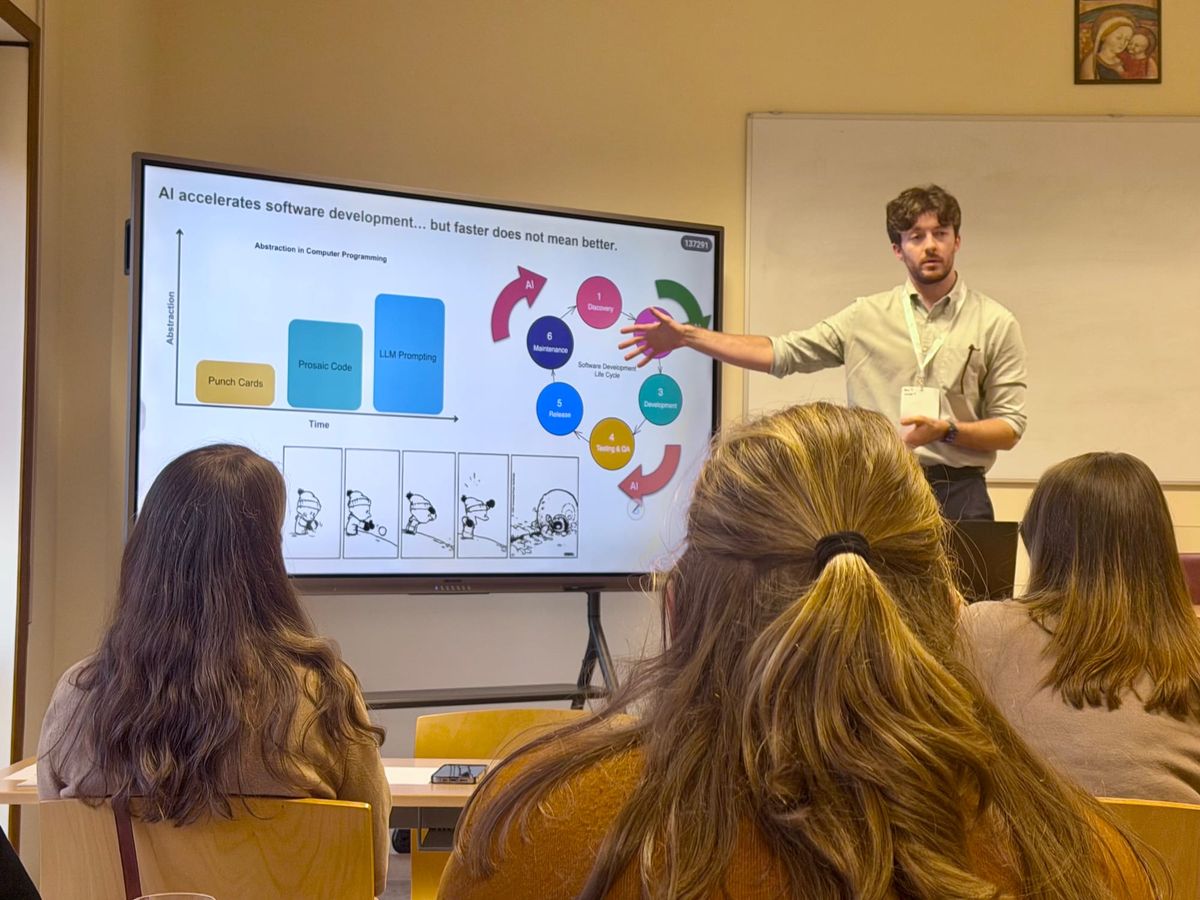
I had the privilege of attending and speaking at Villanova's inaugural International Sustainability Conference a few weeks ago in Rome. Whenever I go to Rome, I visit the Basilica di San Clemente. From outside, it's a nondescript church a few blocks from the Colosseum.
The ground-level church is a lovely 11th-century cathedral, but there's an antechamber with a staircase leading down into the past. At the first level down, there's a 4th century chapel with ancient frescoes slowly decaying.
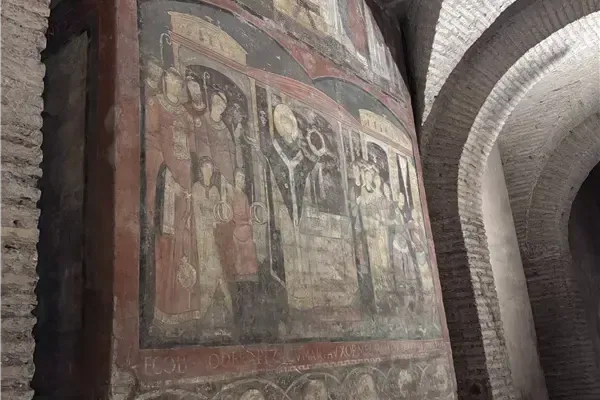
There's a series of chambers to pass through before another staircase is revealed. Beneath this church lies a pre-Christian Rome, a series of chambers and passages and a Mithraic temple. Down there, rushing water echoes in the dim chambers, the humidity fueling the growth of moss-patches in the brightest areas. There's a mineral taste to the air as you pass through the chambers, often walking through walls that the excavators knocked down two centuries ago.
It's a walk through the sediment of lifetimes, and I leave feeling small. The Eternal City is filled with these places, where the accumulated past overwhelms the present person. One person cannot appreciate all the history for the taking there, and the more you see, the less you witness. The Capitoline Museum becomes a warehouse, the Forum a park full of stones.
I was at the conference to speak on the relationship between artificial intelligence and software development, and this concept of overwhelm through abundance kept coming back to me. AI has flooded the zones of our attention, especially in the digital world, cheapening so many forms of creation that only a few years ago were solely human domains, and it's easily exhausting.
Where the historical overwhelm of Roman antiquity leaves the traveler in awe of just how much remains of the past, of the creativity and skill of long-past craftspeople, of lives once lived fully in these ruins; the present overwhelm of AI leaves a lingering nausea. Cheaply generated slop fills the internet and, increasingly, reality (the amount of AI-generated souvenirs and advertisements in Rome surprised me). The undeniable truth that all AI content derives from vast troves of questionably acquired and uncredited human experience adds a layer of guilt, as does the slimy feeling of cognitive delegation. I've addressed that before.
 Jack T. Crawford

My talk at the conference, An Army of Commanders, examined the detrimental effects of cognitive delegation and reaffirmed that, while software development is one of the few places where AI can produce quality, developers must constantly reexamine their relationship with those tools. I'm continuing to process my thoughts on how AI has robbed the development process of joy, something I'll return to in a later piece.
There wasn't much focus on AI in the larger sessions of the conference, but one moment did stand out. A professor from a university in Belgium spoke on a survey that she and her team had conducted about what people did and did not want AI to do. A major recurring theme in the results was this: AI should not remove the human right to struggle. When AI robs a life, a practice, a job of its friction, it robs the person's ability to grow. Without challenge/friction/struggle, we do not grow, we wither. The great questions we must ask are: How will we preserve sources of friction? Which struggles are valuable, and which ones aren't?
The last type of overwhelm, the most pressing, was one of fought-off despair. It permeated the atmosphere of the Augustinianum. This lurking despair is a felt response to the apathy of the world towards the environment, towards the poor. It's a question mark that lurks in the hollow of Dr. King's line about the moral arc of the universe. When you cannot see the bend, you start to wonder if it's there at all.
This conference was unmatched in its diversity, with speakers and attendees from across the globe. Some attendees were able to speak openly there in ways that they could not have in their home countries, out of fear of violent retribution. Whether they were from South Sudan or Appalachia, their questions often alluded to the overwhelm, though nobody named it outright.
Instead, the questions would illuminate the despair's outline, variations on "How do we get people to care? How do we make change in communities who are unwilling to listen? When we are called to build an integral ecology, to approach the world relationally, how do we approach those who refuse to see through that lens? How do we fight the inertia of an apathetic world?"
These questions were broad because the problems are universal, and often left panelists struggling for answers, but two speakers handled the question of despair in ways that stuck with me.
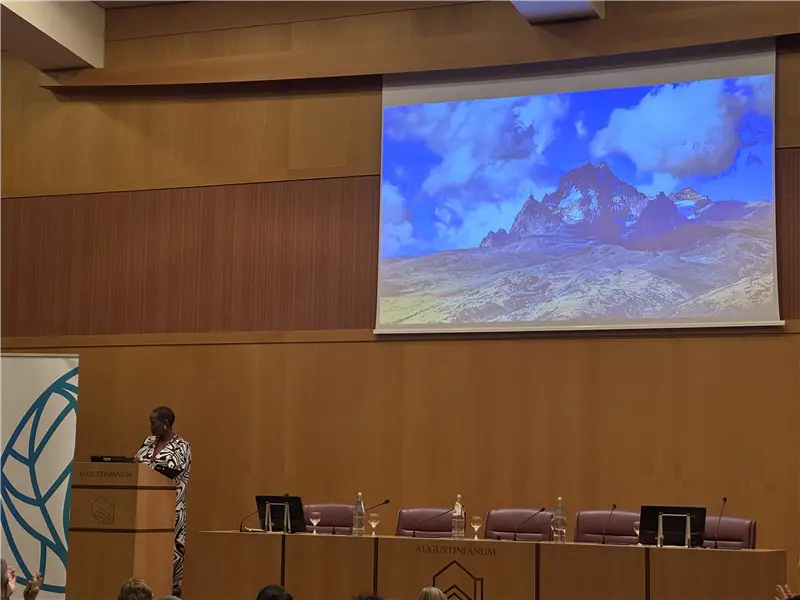
Wanjira Mathai, a Kenyan environmentalist and activist, told a story that her mother had told her, one I cannot relay with half her ability though, of course, I must try. She described a community in the highlands of Kenya who maintained a community resource called the Granary of God. This was a beautifully elegant solution for the pooling of communal resources for the hungry, a granary tucked in a discrete spot so that anyone coming or going from the pantry wouldn't be seen. There was anonymity and humility for those with enough to share, and crucially, privacy and dignity, for those who went in need.
Compassion was built into the very nature of the place, and it reminded me that any sustainable change must build in this way. In the face of problems that seem to overwhelm the world, compassionate subsidiarity provides a path forward.
The inaugural recipient of the Pope Leo XIV Sustainability Medal, Cardinal Michael Czerny, spoke on changing peoples' hearts. It's not possible to force minds to change, to Clockwork Orange people into thinking in a certain way (my reference, not his). Change comes in small moments of illumination and connection, what he called "angel moments", where relationships drive change organically. This harkens back to the integral ecological nature of our world. When we accept that reality is relational, we can recognize that how we relate, how we connect, those are the avenues to social and environmental impact.
Those two speakers shone some light on the path for me, cutting back the overwhelm, and I'm truly grateful for the chance to hear their stories.
"A man cannot despair if he can imagine a better life, and if he can enact something of its possibility" - Wendell Berry (An Entrance to the Woods).